
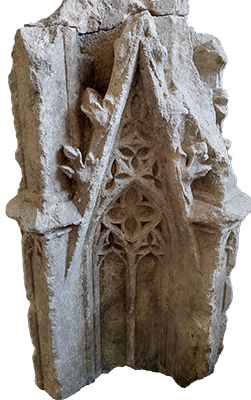
This piece is the counterpart of a similar one that remained permanently embedded in the masonry where it was discovered – the north facade of the former Preposit’s Palace (the current museum). Its extraction would have affected the integrity of the wall. Like other pieces in our museum, this piece has been transformed into masonry material, probably from a construction inside the Roman Catholic Cathedral of Alba Iulia. Recycling resources was a practice that, as we can see, existed even in the medieval period, with the same logic as the contemporary ones.
Many such architectural components of the cathedral have disappeared over time due to the successive construction phases of this iconic monument.
However, this fragment has a pronounced aesthetic component. The meticulous and very fine decoration, the delicate tracery, and the different sides all introduce us to the much more refined world of the “Rayonnant Gothic” style. We can infer that it was part of a tall interior structure, perhaps the roof of a pulpit, in the form of a canopy, from where sermons were delivered to the faithful present at the service. However, we can also let our imagination run wild and imagine that this pinnacle was part of the roof of an altar, also in the form of a canopy.
The “Rayonnant Gothic” to which we could attribute this fragment was first experimented with at the Cathedral of Amiens (France) and reached its peak at the one in Cologne (Germany). You easily recognize it where cathedrals have rosette-shaped windows, abundant interior and exterior decorations, intricate stone tracery, and immense stained glass windows. The impression of the massiveness of the stone is annulled, everything becoming fluid, almost immaterial.