
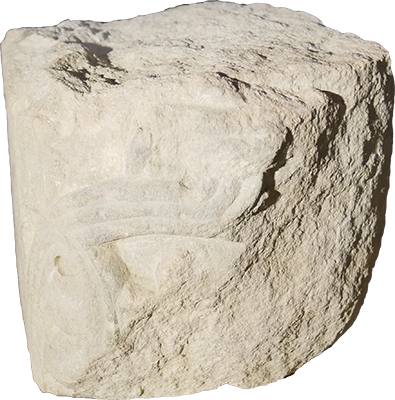
The story of this fragment is the story of many other such stone fragments. Whether we are talking about parts of different columns or funerary monuments, inscriptions and decorated frames, all are extracted from various Roman constructions or parts lost from the Roman Catholic Cathedral of the citadel, after its initial construction phases. For example, this piece was brought after one of the two original southern entrances of the cathedral disappeared, along with its entire stone decoration, probably a beautiful composition with columns, gate frames, and decorations.
It was hidden from the world until recently when it was unveiled from the mass of masonry that makes up the northern facade of The Princes` Palace, the entrance to the museum. It is the moment when it was extracted during the renovations, along with other such fragments from the lost portal of the cathedral identified during the building’s restoration.
The identity of this column fragment is linked to an architectural style that first appeared in the 10th century, 200 years before the piece in the exhibition. This style was called Romanesque and appeared in a famous place, Cluny, somewhere in France, where a well-known Benedictine monastic order operated – the order founded by St. Benedict. The main characteristic of this style is the more massive appearance of the constructions, with semicircular stone vault roofs supported by massive pillars. Inside and on the facades, a series of columns are lined up, united by semicircular arches, and the walls are adorned with sculptures depicting kind and naively represented characters, fantastic animals, geometric and vegetal decorations. The windows also have a semicircular shape, small and narrow, with a small opening on the outside and widened on the inside. The basic motif is the curved line, as in the Gothic style, which, as we will see, is the broken line.