
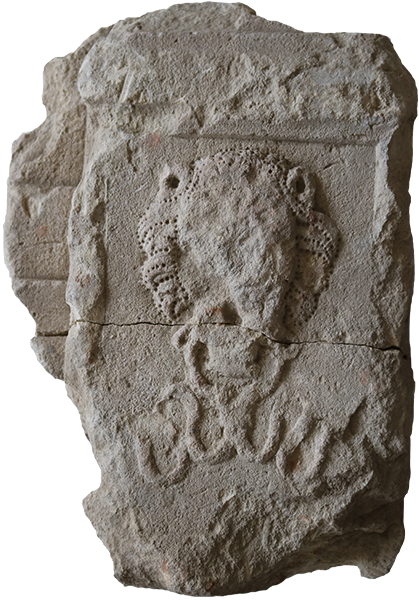
Limestone, early 16th c.
The Story
If we were faced with a puzzle, this piece would fit precisely at the point where a stone column supporting a door frame rises. We chose this piece for the relief representing a lion’s head seen from the front, holding a circular ring in its mouth, similar to the thick iron rings used to knock on the door of an old house or castle owner.
The piece closely resembles one from the exterior portal of the Lázói Chapel in the Roman Catholic Cathedral (1512), built by a former high prelate.
Although the piece was reused in the structure of a chimney built in the early 19th century, we presume that it originally belonged to the Prepositus Palace ensemble, contemporary with the coat of arms of Bishop Francisc Várday (Bishop of Transylvania between 1514-1524).
The presence of the lion’s head on the base of a portal is not only a beloved decorative motif of Renaissance art but also refers to an ancient representation of lions flanking gates and portals with a clear significance—the guardians of access points.